A 10,000 lux light therapy box and the overhead fixture already installed in most kitchens look almost identical from across the room — both throw white light, both have a switch you flip without thinking. One of them can reset a circadian rhythm that a dark San Francisco winter has thrown out of sync, which is the entire case for winter sleep fixes like this one. The other barely registers as biological dusk.
Here's the myth that gets repeated in nearly every winter-sleep post out there: flip the light box on the second your alarm goes off, sit under it for twenty minutes, problem solved. It's not that simple, and treating it like it is explains why so many people buy an expensive lamp, use it for a week, feel nothing, and shove it in a closet by February. Timing and placement aren't footnotes here. They're most of the mechanism.
I'll say the obvious part once: I'm not a sleep doctor, a sleep coach, or anyone with letters after her name. I'm a marketing director who got tired of being tired and started paying close attention to what actually moved the needle on my own ridiculous schedule. If something bigger than winter grogginess is going on for you, that's a conversation for an actual doctor, not a blog post about a lamp.
The Placement Mistake That Turns a Light Box Into a Headache Machine
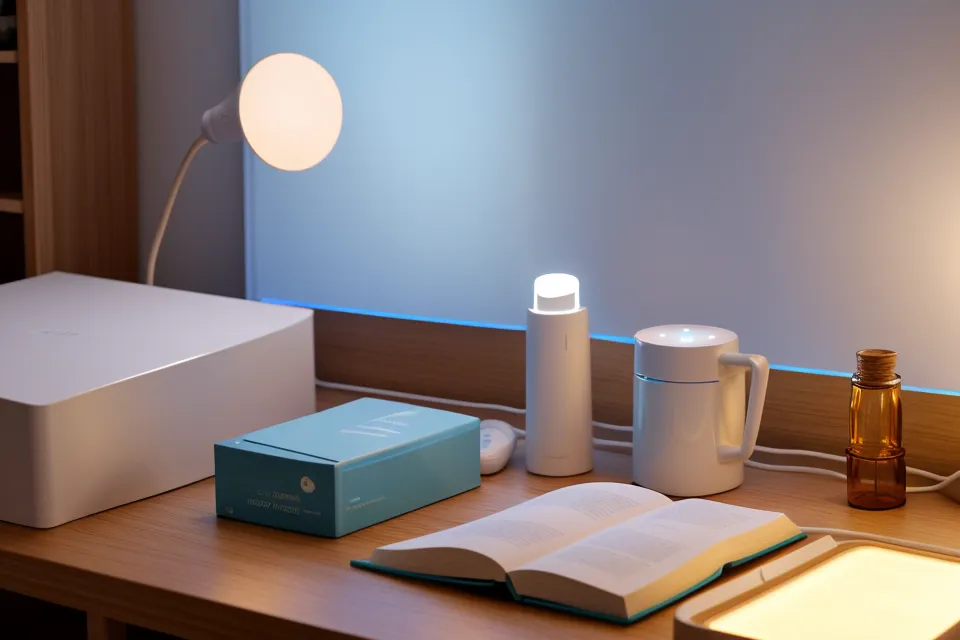
Most people's first instinct is to prop the box flat on the desk and stare straight into it while answering email. Mine was too, the week it arrived — ten minutes in, I had a headache like I'd been driving straight into oncoming headlights. A panel that genuinely delivers 10,000 lux only does its job when it's angled slightly above eye level and sits roughly sixteen to twenty-four inches from your face, landing in your peripheral vision instead of dead center. Stare straight into it and you're not doing light therapy anymore, you're doing self-inflicted eye strain with extra steps.
Twenty to thirty minutes a day is the window most sources agree on, and the easiest way to hit it without turning your morning into a meditation retreat is to pair it with something you're already doing — breakfast, the first pass through your inbox, whatever low-stakes task doesn't need direct eye contact with a screen. The box does the work in the background. You don't have to sit there reverently absorbing photons.
A Very Short Biology Detour
Here's the one piece of biology I'll get into, because it explains why dim indoor light doesn't cut it: your eyes have a separate set of light-sensing cells — intrinsically photosensitive retinal ganglion cells, if you want the full name — whose entire job is telling your brain whether it's day or night. They need a lot more brightness than a regular lamp provides before they'll register "morning" at all. That's it, that's the whole biology lecture. Everything else here is about using the box correctly, not re-teaching a physiology class.
The Timing Mistake That Fights Your Circadian Clock
The instructions printed on most light box packaging say to turn it on the second your alarm rings. For some people that's fine. For anyone with a naturally later internal clock — someone whose body doesn't want its core temperature to hit its lowest point until well into the morning — that advice backfires badly. Blast 10,000 lux into those eyes before the body's ready to call it morning, and the brain reads it as evening light instead, nudging the internal clock later rather than earlier.
I made exactly this mistake, forcing myself up earlier than my body had any interest in and parking in front of the box before it was willing to cooperate. The result wasn't a faster reset. It was lying there wired long past midnight, baffled that a supposedly circadian-friendly habit seemed to be actively fighting my circadian rhythm instead of helping it.
Zora Asked Bluntly, and She Had a Point
A reader named Zora emailed me after a piece I wrote about productivity and sleep — not a comment, an actual email, sent the same week she'd caught herself asleep at her desk during a grant deadline. She runs programs at a nonprofit, which means she can't throw money at a problem the way a corporate budget sometimes lets me, and she wanted to know, bluntly, whether a light box was worth buying or just an expensive way to feel productive about being tired. Bluntly is the right word for how she asks things, and I appreciated it.
My answer: anchor the timing to when you actually wake up, not to when you wish you woke up. If you're naturally up around seven, the session happens around seven — not at five-thirty because some printed insert insists earlier is always better. Once I moved my own session to match my real wake time instead of an aspirational one, the effect went from nothing to noticeable almost right away. That's the correction worth remembering here: the box isn't broken when it doesn't work on the first try. The schedule it's running on usually is.
What a Light Box Can't Fix
A light box will not fix a schedule that has you answering Slack at eleven at night. It won't undo a calendar that runs back-to-back from eight to six. The evening side of this matters just as much as the morning side — something that helps the body downshift before bed does more good paired with a consistent morning light cue than either does alone, which is roughly the territory I covered when I wrote about why I use a warm bath before bed to decompress after work. The same logic applies to what's lighting your bedroom at nine at night; best bedroom lighting for better sleep and calmer evenings covers the fixtures that quietly undo a morning's worth of progress.
Before I understood any of this, I tried to out-engineer my own exhaustion with sheer enforcement. At one point I had eleven separate phone alarms set to impose a strict bedtime on myself, each one labeled with an increasingly aggressive message, and I actually hit that bedtime maybe twice. The problem was never that I lacked a reminder. The problem was that nothing was signaling "daytime" clearly enough to my body, so nighttime never arrived on schedule either, no matter how many alarms I stacked on top of the issue.
My college friend Sasha — the one who sent me a sleep-tracking app link back when I had zero interest in using it — used to get screenshots from me first thing in the morning, before coffee, before anything coherent: a readout claiming an hour and forty-two minutes of deep sleep, sent at six-thirty like it was breaking news she needed immediately. Staring at that number every morning never fixed anything on its own. Getting consistent morning light, paired with going to bed when I was actually tired instead of when a chart told me I should be, did.
So, What Should You Actually Do With the Thing?
Skip the aesthetic desk lamps marketed as light therapy — plenty of them put out under 2,000 lux unless the panel is pressed against your cheek, which defeats the entire purpose. Confirm the unit actually delivers 10,000 lux at a working distance you'll tolerate, angle it up and off to the side rather than straight at your eyes, and give it twenty to thirty minutes timed to whenever you genuinely wake up, not whenever you wish you did. Don't judge the results after one foggy Tuesday — bodies recalibrate slower than inboxes do, and the people who give up fastest are usually the ones who had the timing backwards from day one.
If your eyes feel gritty afterward instead of alert, that's worth troubleshooting on its own; I've gone into that separately in managing eye strain and sleep quality after screen time. The myth isn't that light therapy doesn't work. The myth is that timing and placement are optional details instead of the entire mechanism.
Winter in San Francisco isn't going anywhere, and neither is a job that expects you online before the fog lifts. A light box angled correctly and timed to your real wake-up won't clear a single unread email. It will give your body one clear, consistent signal in a season that otherwise sends none — and that one signal turns out to be most of the fix.