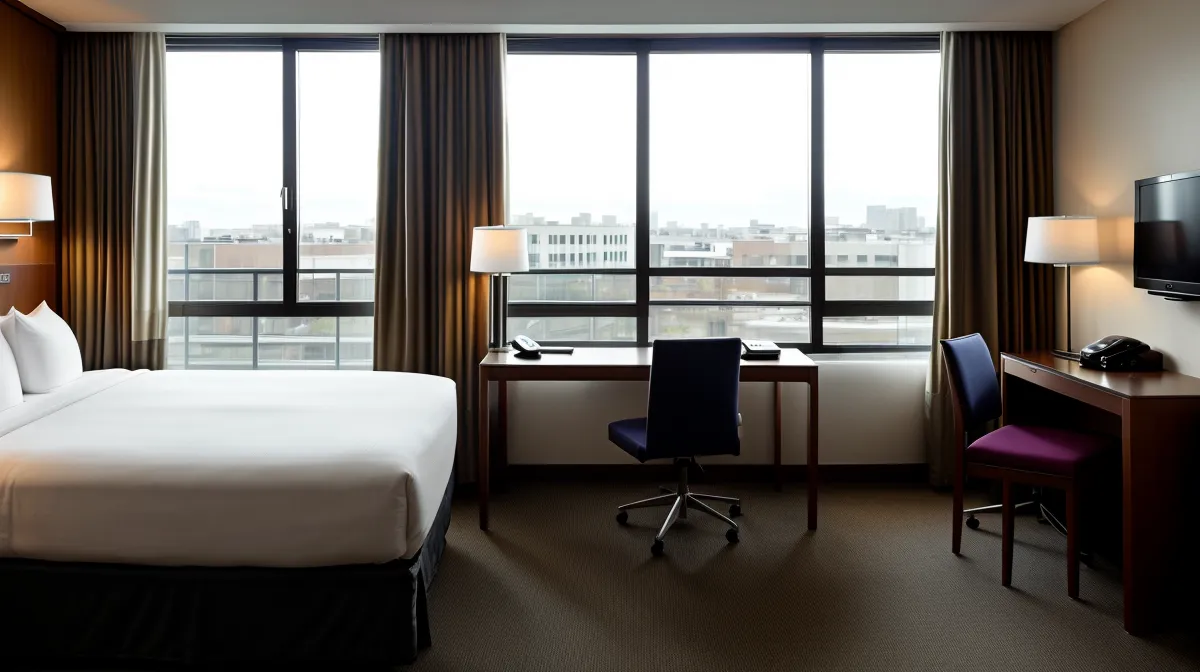
Three black binder clips and a roll of electrical tape live permanently in the zip pocket of my carry-on, the way a stapler lives in a desk drawer. Business travel turned me into someone who packs for sleep as deliberately as I pack for a pitch. Every hotel room forces the same question — is this a one-night turnaround or a five-night stretch — because the two need completely different sleep optimization tactics, and treating them the same is where most business travel insomnia hacks fall apart before they even start. Work-life balance stops being an abstract idea on the road and starts being a scheduling problem you solve room by room.
Here’s the actual split. A one-night trip — land, present, fly home before your body even registers the time change — lives or dies on the room itself: the light, the temperature, the noise. A four- or five-night conference does too, but it also runs into something bigger, which is that your body’s clock doesn’t reset just because your calendar says you’re in a different city. On a short trip I’m fighting the room. On a long one I’m also fighting my own circadian anchor, and that anchor has to travel with me — same wake time, same first hit of morning light, no matter what the mattress, the room, or the time zone throw at it. Sleep debt compounds fast over a five-night stretch in a way one bad night never does, and that difference is the whole reason these need two different playbooks.
Why Business Travel Insomnia Hacks Depend on Trip Length
On an ordinary week at home, I work from a corner table at Blue Bottle Coffee inside the Ferry Building most mornings, and caffeine timing barely matters — I know my own rhythm well enough to stop drinking coffee with enough runway before bed. On the road, that math falls apart. Hotel coffee service runs later, meetings run into what should be my cutoff, and caffeine’s half-life means a 2 p.m. latte is still doing something to your system at 10 p.m. in a room you don’t recognize. For a one-night trip, I skip the afternoon coffee entirely and eat the fatigue. For a longer stretch, cutting caffeine early enough to matter takes actual planning, because the meetings don’t stop just because the sun’s going down.
Light, temperature, and noise make up the whole environment stack in a hotel room, and no single fix matters as much as getting all three working together. Hotel rooms trigger something sleep researchers call the ‘First Night Effect’ — your body treats an unfamiliar space as slightly less safe than your own bed, no matter how nice the sheets are. That’s true whether you’re there for one night or five, so it’s worth solving regardless of trip type.
Sealing Out Every Light Source
My first move in any room is the light audit: snap the binder clips over that one-inch gap hotel blackout curtains always seem to leave in the middle, then tape over every LED — the microwave clock, the thermostat glow, the TV standby light. If it emits light, it gets covered. Total darkness is the goal, dark enough that I can’t see my hand in front of my face, which signals to my circadian rhythm that the workday is actually over.
The Thermostat Fight: One Night Versus Five
Most modern hotel thermostats are motion-sensing. Stop moving for two hours — because you’re asleep, which is the whole point — and the unit assumes the room’s empty and lets the temperature drift. A search for the model number usually turns up a maintenance override, some button combo held for a few seconds, that locks the fan running and the temperature stable overnight. I set mine to 67 degrees.

On a one-night trip, the override is enough — the sheets are what they are for one night. On a longer trip, the sheets start to matter more, because heavy or synthetic linens compound the same discomfort night after night instead of just once. I’ve written before about finding the best cooling mattress pads for high stress night sweats, and while a mattress pad obviously doesn’t fit in a suitcase, a lightweight silk travel liner does — the difference between the room feeling rough by night four or not. For one night, skip the extra packing weight. For five, bring it.
Total Blackout or the Visual Anchor?
Total blackout has a real cost on longer trips that it doesn’t have on short ones. Wake up at 3 a.m. in a room that’s fully black and unfamiliar, and not knowing where the door is spikes cortisol fast, in a way your own dark bedroom never does.
On a one-night trip I still take the total-blackout risk, because I only have to survive one night of it. On a stay that runs four or five nights, I leave the bathroom door cracked with a little hallway light bleeding through instead — a faint visual anchor that lets my brain place the room in a few seconds instead of jolting fully awake to figure it out. That grogginess right after waking — sleep inertia — clears faster with a sliver of light in the room than with total black, which is one more point for the visual anchor on anything longer than a single night.
Screens in the Suitcase, or Screens on the Nightstand
The hardest part of business travel isn’t the bed, it’s the always-on expectation. Cross three time zones and your home team is still firing off questions at what feels like evening to you and mid-afternoon to them. I used to answer from bed and call it efficient, when what I was actually doing was keeping my brain lit up right when it should have been powering down for the night.
My friend Sasha Moretti, a product manager at a SaaS startup, calls most Sunday mornings and asks how the sleep’s been — a question that used to make me deflect and now just gets an honest answer. That answer changes with the trip. On a one-night turnaround, I let messages sit later than I’d like, because there’s only one night at stake and I’d rather protect the flight home than the evening. On a longer stretch, the laptop goes into the suitcase, zipped, 90 minutes before I want to be asleep, because ‘the desk’ doesn’t count as out of sight. The fan spins down, the screen goes black, and there’s a particular kind of quiet in that half-second that means the workday is actually, finally over — not just paused — and I only get that quiet when I commit to it ahead of time. If I absolutely have to send one more note, I’ll do it wearing blue light blocking glasses for late night emails, but that’s a patch, not a fix.
Instead of scrolling, I do what I think of as brain dumping: grab the hotel notepad and write down everything I’m worried about for the next day, the client reaction, the budget line, the flight home, all of it. It’s a simplified version of what I’ve covered in journaling for better sleep. Getting the thoughts onto paper stops them from circling while I’m trying to fall asleep, and it works about the same whether it’s night one or night five.
Networking Dinners Force a Trade-off on Alcohol
Client dinners and happy hours are part of the job, and in my industry, turning down a drink can read as a small social failure even when nobody says so out loud. But alcohol sedates you, it doesn’t put you to sleep — those are two different states, whatever it feels like at 11 p.m. You’ll drop off fast and then jolt awake around 3:15 a.m., heart going, because the rebound disrupts the structure of the night’s rest, not just the total hours.
On a one-night trip before an early flight, I skip the wine entirely — one bad night is too expensive when there’s no recovery night after it. On a longer trip I budget for it instead: one glass early, then sparkling water with lime for the rest of the evening, an early call as my exit line, which is usually true anyway. Handling alcohol and sleep quality at networking events is still something I negotiate trip by trip, not a rule I’ve fully solved. When a late night happens anyway, I lean on hydration — for a stretch, I tried a magnesium spray that was supposed to help, and it mostly just left the pillow feeling greasy without doing much for how I actually slept. What’s stuck instead is reading into magnesium for sleep and anxiety in forms that don’t end up on the pillowcase.
So Which Protocol Actually Wins?
Neither one, across the board — that’s the point of treating these as two cases instead of one list. For a one-night turnaround: full blackout, the thermostat override, skip the wine, let messages sit. For a multi-night stretch: the visual anchor instead of total dark, the travel liner, the laptop actually zipped away, and a drink budgeted rather than skipped outright. The short trip rewards going hard on the room. The long trip rewards protecting the same routine across several nights instead of just the one.
A reader named Zora Hepburn, who works in nonprofit management, emailed after a piece I wrote on productivity and sleep to say the cheap fixes — the clips, the tape — did more for her than anything else on the list, and she still checks back every few months with what’s stuck and what hasn’t. That tracks with what I keep seeing trip after trip: the unglamorous stuff wins more often than the expensive stuff. The clearest sign any of it is working isn’t a great night of sleep, honestly — it’s smaller than that. It’s sitting through an 8 p.m. client deck review and having full, coherent sentences come out instead of grasping for a word that used to be right there. You don’t need a perfect system for that. You need the right protocol for the trip you’re actually on.