
Four bottles. That's the entire tally of sleep supplements behind the fix for a stretch of executive burnout so bad it nearly cost me a presentation in front of the people who sign my performance review — not a four-figure biohacking stack, not a subscription with a name I can't pronounce, just four bottles of the cheapest option on the shelf, adding up to a total investment in the low three figures.
Update (September 2026): Resurge is no longer available for purchase; this article is kept for reference. Our current value pick in this category is ChronoBoost Pro.
Here's the disclosure, out of the way early: this post contains affiliate links, including the ones for the sleep supplements I mention below. If you buy through them, I earn a commission at no extra cost to you. I only write about products I've actually used during real work weeks, and I'm not a doctor, a sleep coach, or a wellness influencer — just someone in marketing who got sick of being useless by mid-afternoon. Talk to your own doctor before changing your supplement routine. Disclosure done.
Cheap Doesn't Mean Useless When You're Running on Fumes
There's a persistent myth in the sleep-optimization corner of the internet: if a supplement is affordable, it's basically decorative. Real executive burnout — the kind that makes you go blank mid-sentence in front of senior leadership — supposedly needs something with a longer ingredient list and a bigger price tag to even register. I believed a version of that myth myself, right up until my brain genuinely stalled out during a presentation and the word I needed just wasn't there. My colleague Winifred was in the room for that one. She still brings it up occasionally, usually to make a point about paying attention to your own limits, delivered with the kind of gentle smugness only someone who color-codes her calendar in four different shades can manage, which is frankly both a little inspiring and a little enraging.
The honest answer is no, not automatically — but it depends entirely on what you're asking the supplement to do. A budget pick can genuinely support deep sleep through a rough patch. What it usually can't do is fix a sleep-wake schedule that's been broken for a long stretch, because that's a structural problem with a structural fix, not a bottle you take before bed.
The Travel Problem No Sleep Hack Warned Me About
Standard advice about dimming the lights two hours before bed assumes you're sleeping in the same bed most nights, which stopped being true once travel became part of the job. Constant shifts to my circadian rhythm, combined with a rotation of interchangeable hotel rooms, wiped out the kind of consistency that actually anchors a body clock, and no amount of good intentions fixed that from a hotel desk chair.
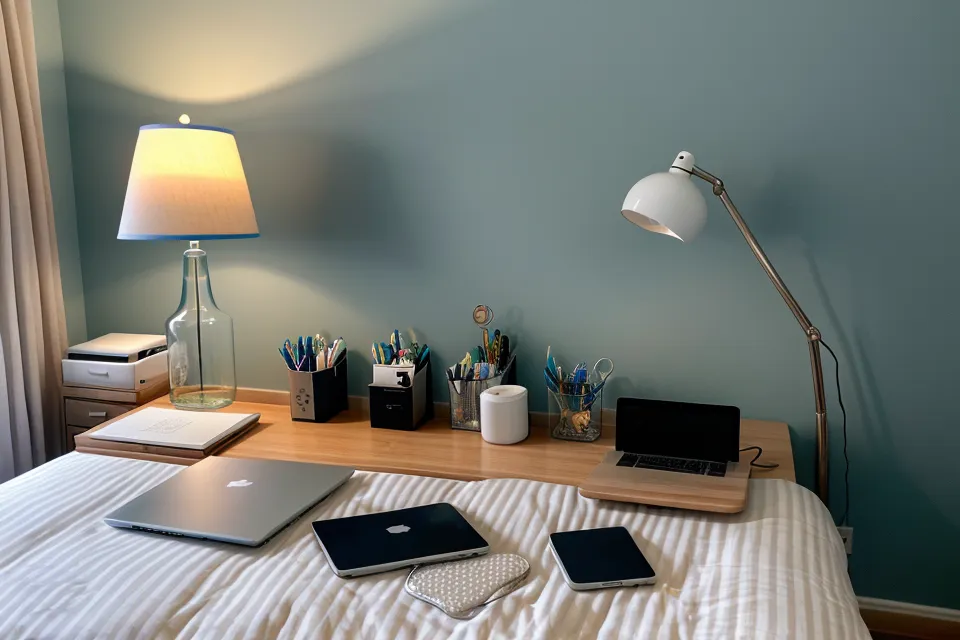
Before I found something that worked around all that, I ran through a small graveyard of things that didn't. I tried using a weighted blanket for anxiety during the worst of the late-night spirals, and it mostly made me feel pinned down and sweaty. Sleep meditation podcasts were somehow worse — the narrator's voice would kick my brain into analysis mode, picking apart word choice instead of letting me drift, which is the opposite of what that kind of podcast is supposed to do for anyone.
Some of this became obvious in small, unglamorous ways. There was a whole cool stretch of mattress next to me some mornings that I clearly hadn't rolled into overnight, which turned out to be a decent sign I'd stayed mostly still instead of thrashing. At a routine cleaning, my dentist mentioned, completely unprompted, that my jaw looked less clenched than usual — before I'd said a single word about sleep to her. That kind of feedback from someone who wasn't even asking about it landed harder than any tracker would have. These days I take lunch at Dolores Park a few times a week, and it's become the easiest gauge I have for how wired I still am: if I can't sit still for fifteen minutes without reaching for my phone, that's data too.
Why I Started With the Fifty-Dollar Option
This ends up being close to a full Resurge review whether I planned it that way or not, so I'll just say it straight. I wasn't ready to drop a fortune on an unproven premium stack, so I looked for something to get me through a genuinely brutal stretch without a big financial commitment. I landed on Resurge, which ran around fifty bucks a bottle — not a price that requires a budget meeting with yourself — and by the time I'd bought enough to feel like I'd actually given it a fair shot, the total sat in the low three figures.
I kept up my journaling for better sleep routine the entire time too, mostly to get the workday out of my head before it followed me into bed, so it's fair to say the supplement wasn't working alone.

The Cortisol Problem Budget Supplements Aren't Supposed to Touch
Work stress does something specific and unglamorous to cortisol, the hormone that's supposed to taper off at night and, for a long stretch, did the opposite for me. I started reading about how to lower cortisol levels during the day instead of only at bedtime, on the theory that a 9 p.m. supplement can't undo a spike that started at a 9 a.m. status meeting. Some of the fix ended up physical — blackout curtains bought in a 2 a.m. online-shopping spiral after one too many ruined Saturday mornings, and, less successfully, a standing desk in the corner of my bedroom where the laptop still ends up open some nights well after ten, undercutting every good intention I have about staying off screens before bed. None of that touches cortisol directly. It just removes a few of the reasons it stays elevated in the first place.

Judging a Sleep Optimization Pick by What It's Actually For
A reader named Belinda messaged me after I first wrote about that stalled-out presentation — she'd had her own version of it during a Zoom all-hands and works in healthcare administration, where scheduling chaos is basically built into the job. She tracks everything she tries in a spreadsheet before committing to anything new, which is a far more disciplined system than whatever I had going during my worst stretch, and her question was basically the one I keep coming back to: how do you actually know if a cheap fix is working, versus just having gotten used to being tired?
The answer isn't about price. It's about whether something is helping you get deeper sleep or just knocking you out, and those aren't the same thing — sedation isn't the same as rebuilding a healthy stretch of real sleep architecture; one just switches you off, the other actually restores you. I also check how much of the problem is old sleep debt piling up from months of short nights, versus a same-day issue, because a cheap supplement can't undo a backlog it didn't cause. Caffeine timing matters more than most people account for, too — coffee hangs around in your system a lot longer than the buzz does, so an early-afternoon habit can still be working against you at bedtime. And if I wake up groggy no matter how many hours I logged, that's usually sleep inertia, not a failed supplement — it just means I surfaced mid-cycle instead of between cycles. I've started treating the whole decision the way I'd vet a new vendor at work: what is this actually promising, and is that different from what the packaging implies?
Where Resurge Fits, and Where It Doesn't
So no, cheap doesn't automatically mean useless, and expensive doesn't automatically mean better suited to your actual problem. Resurge is a reasonable place to start if you need a lower-cost way to support deep sleep through a temporary rough patch, and you're willing to give it more than a few nights before judging it — it's an older formula that hasn't been updated in a while, and results took longer to show up for me than I expected going in, which I want to be upfront about instead of pretending otherwise.
Once the worst of that stretch passed, I still wanted more than 'good enough,' so I looked at YU SLEEP next. It's positioned for people dealing with ongoing executive burnout rather than a temporary rough patch, and it's noticeably pricier, which tracks with it doing more. If metabolic goals are also part of what you're solving for, SleepLean is the one built around both at once, though it sits at the highest price point of the three and won't matter to you at all if weight isn't part of the equation.
None of the three replaces an honest look at why your cortisol won't quit or why your schedule keeps eating your evenings. I still don't always follow my own advice — some weeks, the inbox still wins over the bedtime I planned for myself, standing desk and laptop included. This was never really a work-life balance manifesto; it's smaller and more specific than that: which fifty-dollar bottle earns a spot on your nightstand, which one doesn't, and why the price tag was never actually the deciding factor.